If you’ve been building post-frame structures long enough, you already know that the details that bite you aren’t usually the big structural decisions. They are the intersections, the places where two systems meet, two trades hand off, and two very different materials are expected to coexist for the next fifty years. Chimney flashing on a metal roof is exactly that kind of detail. And on barndominium and post-frame residential builds across Wayne, Cayuga, Oswego, and Onondaga Counties, it’s the one that generates callbacks.
This article is written for post-frame builders and contractors who are incorporating traditional masonry fireplaces and chimneys into their builds, something that is increasingly common as barndominiums in the Finger Lakes region and along the Lake Ontario shoreline become primary residences rather than agricultural or recreational structures. The homeowners commissioning these buildings want the aesthetic and the experience of a real hearth. Your job is to deliver it without leaving a moisture problem that shows up two winters later.
The intersection of a brick chimney and a metal roof is technically demanding in any climate. In Central New York’s lake-effect snow belt, it is unforgiving. Here is what you need to know.
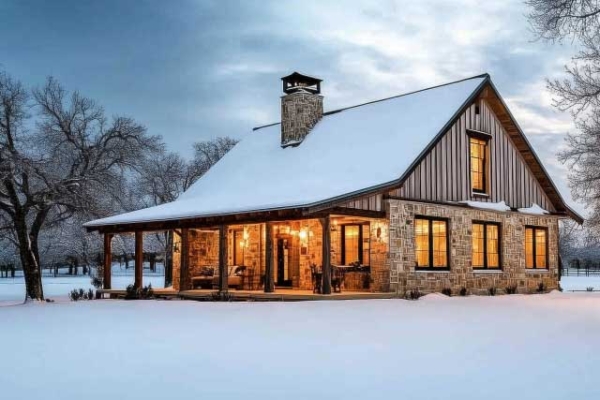
Why This Junction Is Different on a Metal Roof
Most experienced framers and roofers have worked through chimney flashing on asphalt shingle roofs. The approach there is well-established: step flashing woven between shingle courses, counter flashing embedded in mortar joints, a cricket on the uphill side for wider chimneys. The logic transfers to metal roofing but the execution does not, and the margin for error is considerably smaller.
Metal roofing panels move. That is not a defect; it’s physics. Steel and aluminum expand and contract with temperature changes, and the swing between a Lake Ontario-effect winter night and a July afternoon in Cayuga County can be substantial. A standing seam steel roof over a large barndominium span can move a meaningful fraction of an inch across its length between seasons. The masonry chimney penetrating that roof does not move at all. It is a column of brick, mortar, and concrete footing anchored to its own independent foundation, thermally and structurally decoupled from the building around it.
The flashing system has to accommodate constant movement on one side and zero movement on the other — through repeated freeze-thaw cycles, under significant snow loads, while remaining continuously watertight. That is a meaningful engineering problem, and it has to be addressed with the right materials and the right mechanical system.
The panel profile matters too. Standing seam systems where seams lock together and no fasteners penetrate the panel face require clamp-based flashing attachments that ride the seam, preserving the panel’s ability to float freely. Exposed fastener panels allow more conventional flashing approaches but introduce long-term risk at every penetration point. The flashing strategy needs to be specified for the actual roof system on the job, not adapted from a generic detail.
What a Correct Installation Looks Like
A watertight chimney-to-metal-roof connection is a system of components. Each one has a specific job. None of them are optional in this climate.
The Cricket
On any chimney wider than 30 inches, the IRC requires a cricket, a peaked diverter structure built on the uphill side of the chimney to shed water and snow around both sides. In practice, any chimney on a post-frame residential build in the lake-effect belt should have a cricket, full stop, regardless of width. The snow that accumulates behind an unprotected chimney in Oswego or Wayne County doesn’t just create a water load. It creates a sustained moisture reservoir that presses against the flashing joint for weeks or months at a time. A cricket is cheap insurance relative to the cost of the repair it prevents.
The cricket itself needs to be properly flashed where it meets the chimney and where its ridgeline meets the main roof slope. This is its own set of details that has to be thought through, not improvised on the fly.
Base Flashing and Step Flashing
Base flashing wraps the downhill face of the chimney at the roofline. Step flashing, individual L-shaped pieces interleaved with the roofing system, runs up both sides. On a metal roof, the step flashing geometry has to integrate with the specific panel profile. This is not a place for field improvisation. The flashing components need to be formed to fit the panel ribs or seams, and the installer needs to understand both the masonry interface and the roofing system interface simultaneously.
Counter Flashing
Counter flashing is what separates a properly engineered chimney flash from a temporary one. It is cut into the mortar joints of the chimney itself typically in a reglet or saw-cut chase and mechanically locked in place, then pointed with mortar or a compatible flexible sealant. It laps over the top of the base and step flashing, creating a barrier that does not depend on adhesion to function. If water gets behind the counter flashing, it’s directed outward over the base flashing and off the roof. The system works even as the sealant ages.
Counter flashing that is surface-applied, glued or caulked to the face of the chimney rather than embedded in the masonry, will separate. Brick and mortar move with temperature and moisture. The bond between a masonry face and an adhesive is not a long-term weather seal. In this climate, it may not even be a short-term one.
Sealant
High-quality urethane or silicone sealant has a role in this system. It fills movement joints, seals counter flashing reglets after the flashing is set, and provides a secondary barrier at specific transitions. What it does not do is replace mechanical flashing. If the sealant is the primary thing keeping water out of the building, the installation is not correct. In five to ten years, probably sooner in a Central New York winter cycle, that sealant will crack or separate, and the water intrusion will begin.
Where Post-Frame Builders Get Into Trouble
These are the failure modes that show up on callbacks. Some are trade knowledge gaps. Some are scheduling and coordination problems. Most are preventable.
- 01
Skipping or undersizing the cricket. It adds time and cost, and on a tighter-margin job it can look like an easy cut. It is not. On a steep-pitched metal roof in a high-snow environment, the cricket is structural protection for the flashing system. An undersized or poorly flashed cricket fails almost as badly as no cricket at all. - 02
Galvanic corrosion from mismatched metals. Dissimilar metals in contact in the presence of moisture corrode each other electrochemically. Aluminum flashing against a steel panel, or copper against aluminum, will eventually fail from within. All metals in the flashing assembly need to be compatible — typically all steel or all aluminum depending on the roofing system. This needs to be specified, not assumed. - 03
Surface-applied counter flashing. If the counter flashing isn’t embedded in the masonry, it will eventually fail. This is a masonry task as much as a roofing task. If the roofer is doing it without masonry experience, verify they understand what embedded means and what it requires. - 04
Poor mortar joint preparation. Counter flashing set into improperly raked or contaminated mortar joints will not seat correctly, and the pointing material won’t bond. The joint needs to be clean, the correct depth, and properly prepared before anything goes in. This is detail work. - 05
Scope gap between roofing and masonry subs. The roofer assumes the mason is handling the counter flashing. The mason assumes the roofer is managing the roof-side integration. Nobody owns the full system. The result is an installation that looks complete but has gaps in it. The GC or post-frame builder needs to own the scope assignment explicitly and verify the handoff.
That last point is worth dwelling on. The chimney-to-metal-roof junction is inherently a two-trade problem. Masonry on one side, roofing on the other, with a shared interface in the middle. On a post-frame residential build where the GC is coordinating multiple subs, clear scope assignment isn’t just good practice — it’s the difference between a watertight installation and a callback.
Trade Coordination: Who Owns What
The most practical thing a post-frame builder can do on a job with a masonry chimney is establish scope of work in writing before either the roofer or the mason gets on site. The conversation should cover:
- Who is forming and installing the base and step flashing? This should be the roofer, and the components need to be specified for the actual panel system — not generic off-the-shelf pieces that may not integrate with the panel profile.
- Who is cutting the counter flashing reglets and setting the counter flashing? This is masonry work. It requires knowing the mortar joint layout, using the right saw, and properly pointing the joint after the flashing is set. If your roofer is doing this, verify they have masonry experience.
- Who is building and flashing the cricket? The cricket structure is typically framing and roofing. The flashing where the cricket meets the chimney is a masonry-roofing interface. Assign it explicitly.
- Who is doing the final inspection and sign-off? Somebody needs to own the completed system — not just their portion of it. On most jobs, that’s the GC or post-frame builder.
Getting this conversation done before the roof goes on is critical. Correcting a flashing problem after the metal panels are installed is significantly more expensive than doing it right the first time, and on a standing seam system, it may require removing and replacing panels.
For the masonry side of this equation in Central New York, including chimney construction, counter flashing installation, and mortar joint work, having a qualified Central NY masonry subcontractor with demonstrated experience at exactly this kind of chimney-to-metal-roof junction in your network who understands both the technical requirements and the regional climate is a real asset.
The Bottom Line
Barndominiums and post-frame residential buildings are increasingly the primary homes of families across Wayne, Cayuga, Oswego, and Onondaga Counties. The owners commissioning these buildings want them built right, and they are trusting their professional post-frame contractor to know where the risks are, including the ones that won’t show up until the second or third winter.
Chimney flashing on a metal roof is a small line item in the scope of a full post-frame build. The repair bill when it fails is not. In the lake-effect snow belt of Central New York, a failed chimney flash isn’t a slow drip you catch early. It’s ice damming, freeze-thaw damage, water behind the wall assembly, and mold often before the owner realizes anything is wrong.
Know the system. Assign the scope clearly. Use the right materials for the actual roof profile. Put a cricket on it. And make sure the counter flashing is in the masonry, not on it.
Talk to a Post Frame Solutions specialist at Secor Lumber Co., Savannah, NY, supplying post-frame contractors throughout Wayne, Cayuga, Oswego, and Onondaga Counties since 1939.